
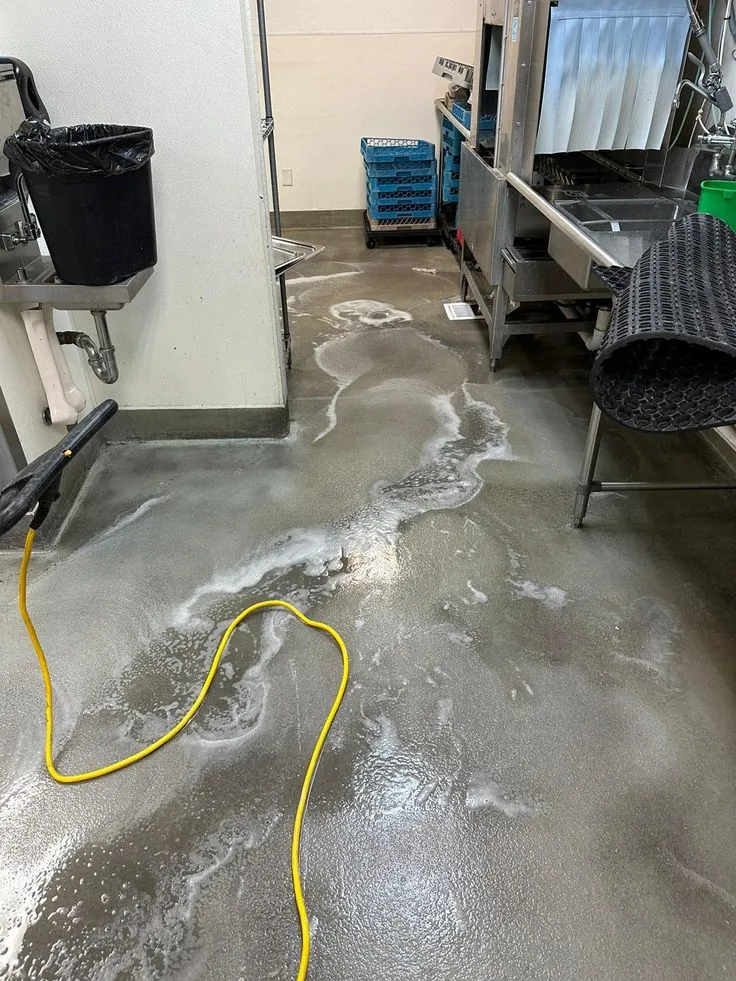
Commercial kitchen floors are cleaned far more aggressively than surfaces in most ordinary workplaces. Degreasers, detergents, disinfectants, hot water, scrubbing equipment, and repeated rinsing may all contact the floor during a single week. These procedures are essential for maintaining sanitary working conditions, but they also place continuous stress on the flooring system. When restaurants or food facilities plan a renovation, cleaning routines should be considered during material selection rather than after installation. A floor that performs well mechanically can still become difficult to maintain if it is not compatible with the facility’s sanitation practices.
Cleaning Frequency Changes Floor Demands
Some restaurant floors receive a light daily wash, while others are scrubbed several times throughout each shift. Food-production environments may use even more intensive sanitation routines.
This difference matters because repeated exposure can affect both the coating and the concrete underneath if the surface becomes damaged. A system intended for occasional cleaning may not be suitable for areas exposed continuously to water and chemicals.
Facility managers should document how often floors are cleaned, what equipment is used, and which locations remain wet for the longest periods.
Chemicals Should Be Discussed Before Installation
Degreasers, disinfectants, detergents, and specialty cleaning products can have different effects on resinous flooring materials.
When evaluating Kitchen Epoxy Flooring Nj, restaurant operators should provide contractors with realistic information about the products used during normal sanitation. Concentration, contact time, temperature, and cleaning frequency can all influence material selection.
A flooring specification should support the existing cleaning program whenever possible rather than forcing employees to adopt impractical procedures simply to protect the surface.
Texture Influences Cleaning Effort
Slip resistance is important in kitchens because grease, water, and food debris can reach the floor during service. However, increasing texture also changes how easily the surface can be cleaned.
Aggressive textures may provide additional traction but can trap grease and residue within the profile. This can require more scrubbing and more time during sanitation.
The ideal surface should balance traction with cleanability according to the conditions in each area. Dishwashing zones, cooking lines, dry storage, and corridors may not all require identical finishes.
Damage Can Make Sanitation Harder
Cracks, chips, peeling coatings, and deteriorated joints can create irregular areas where liquids and debris collect.
Once the protective surface is compromised, cleaning becomes less consistent and the concrete underneath may receive greater exposure to moisture and chemicals. Small defects should therefore be evaluated before they develop into larger maintenance issues.
Facilities planning Food Services Flooring Restoration should look beyond visible appearance and consider whether existing deterioration is interfering with routine sanitation. Repeated patching may be appropriate for isolated damage, while broader resurfacing can make more sense when failures are widespread.
Drains Need Special Attention
Cleaning water ultimately needs somewhere to go. Poor drainage can leave standing water even when the flooring material itself remains in good condition.
Drain surrounds should be inspected for cracks, deteriorated edges, low areas, and old repairs. Slopes should direct water efficiently rather than allowing it to collect in corners or around equipment.
A new coating cannot correct every drainage problem, so substrate and slope issues should be identified before installation begins.
Mechanical Preparation Supports Better Results
Old kitchen floors may contain grease contamination, previous coatings, weak surface material, and damaged concrete. These conditions should be addressed before a new resinous system is applied.
Mechanical preparation such as grinding or shot blasting can remove unsuitable material and create a profile for adhesion. Cracks and deteriorated areas can then be repaired before primers and subsequent layers are installed.
This stage may be less visible than the final finish, but it has a major influence on long-term flooring performance.
Staff Training Matters After Installation
Even a well-designed floor benefits from consistent maintenance. Employees should understand which cleaning chemicals, scrubbers, and procedures are appropriate for the installed system.
Managers can also establish routine inspections around drains, cooking equipment, wall transitions, and heavily traveled areas. These locations often experience concentrated exposure and may show early signs of wear.
Small defects are generally easier to address before repeated cleaning and traffic cause them to expand.
Cleaning Programs Should Evolve With the Floor
Restaurant operations change over time. New equipment, different cleaning products, heavier production, or altered work zones can change what the floor experiences.
Facility managers should periodically review whether the existing maintenance program still matches the flooring system. If cleaning becomes more aggressive or exposure increases, high-risk areas may need more frequent inspection.
This ongoing review can help prevent maintenance practices from unintentionally shortening the useful life of the surface.
Conclusion
Commercial kitchen flooring should be selected with sanitation routines in mind because cleaning is one of the most frequent stresses the surface will experience. Chemical exposure, hot water, texture, drainage, damaged concrete, and cleaning equipment all influence how practical the floor remains over time.
By discussing these conditions before installation, restaurant and food-facility managers can choose a system that supports both daily operations and maintenance. Proper preparation, sensible texture, effective drainage, employee training, and regular inspections can help create a more manageable flooring environment while reducing avoidable restoration work.
